Emit Solar | Home Solar Panels | Easy Ownership
Solar quotes often show more panel capacity (kW) than inverter capacity — this is intentional and called “oversizing” or “overpaneling,” typically at a 1.1–1.3x ratio. Since panels rarely hit their full rated output due to heat, angle, and weather, the extra panel capacity helps generate more energy during low-light conditions, while the inverter simply caps output during peak sun.
More kilowatts of panel than inverter – on purpose.
PANELS (kWp)
1.3kWp
catch the sun – Direct Current (DC)
INVERTER (kWac)
1.0kWac
feed your home – Alternate Current (AC)
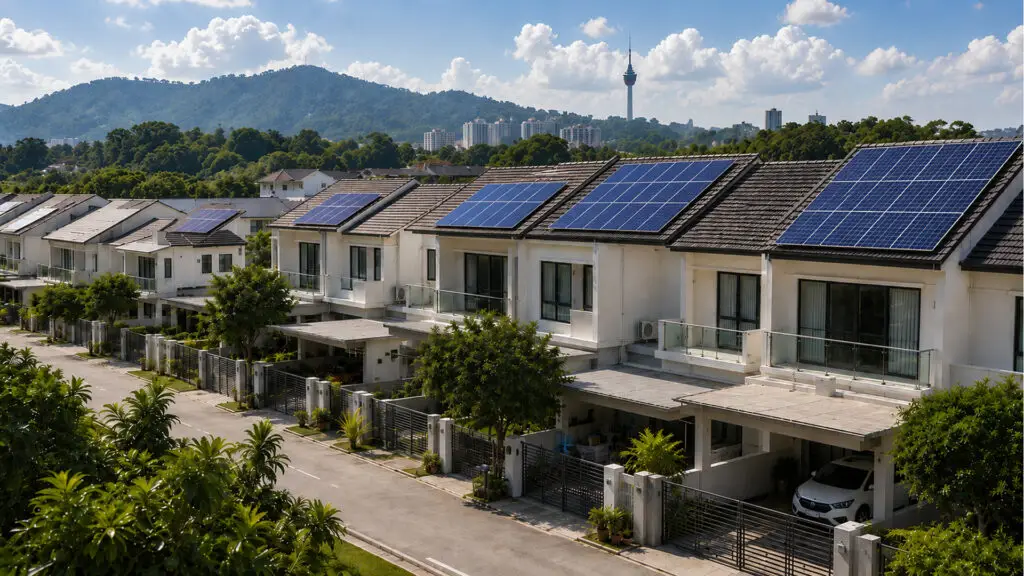
A typical KL home: a DC/AC ratio near 1.3.
It may look odd at first, but it’s a normal part of good solar design. Here’s why the panel number is usually higher.
kWp CATCHES IT, kWac DELIVERS IT
Panels are rated in kWp, or kilowatt-peak – the raw DC sunlight they catch. The inverter is rated in kWac – the AC power it sends to your appliances. Divide one by the other and you get the DC/AC ratio.
For example:
1.3kWp of panels ÷ 1kWac inverter = 1.3 DC/AC ratio
Almost every home solar system is designed above 1.0 – the panel capacity is deliberately higher than the inverter capacity. When designed properly, a good system doesn’t strain the inverter; it keeps voltage and current within the safe operating range.
You never get the number on the box
The kWp on a panel is a lab figure – perfect light, exactly 25°C, perfect test environment. Your KL roof is not a lab.
"The hotter a panel gets, the less it makes."
The Time Solar team
A panel in full sun runs at 50–60°C, not the 34°C air around it. At about −0.40%/°C, that quietly costs 10–15% of the rated output every clear afternoon. A small oversize just closes that gap.
And not all panels cope equally – some carry a lower temperature coefficient and hold their output far better in tropical heat. In a climate like ours, that matters.
Look for panels with a better temperature coefficient For example, the Aiko 670W panels we deploy has a temperature coefficient of -0.26%/°C, compared with around -0.40%/°C for some conventional panels. This helps it retain more output on hot Malaysian roofs.
One thing to check on any quote: that the panels are tested by an accredited lab. Many aren’t.
Your roof has an opinion
Four things about your roof pull output below the rating. Each is a reason to add a few panels.
Tilt – how steep it is
KL sits 3° from the equator, so panels want a low pitch – 10°–22° is the zone. A steep 35–45° roof loses 5–10% a year, so we add that back in panel.
Orientation – which way it faces
South is best, east and west close behind, north last. But near the equator the penalty is small: a north roof gives up only 5–15% and more panels could improve performance.
Mismatch – complex roof shapes
Panels on different faces drag each other down – but in Malaysia, the impact is small, since the high overhead sun keeps the faces close. Extra panels can cover it.
Shading – anything that blocks the sun
A fixed shadow is the worst thing for solar. The fix: panels with anti-shading technology, plus a few extra to recover the rest.
A fuller curve covers more of your usage
Use electricity in daylight – working from home, daytime aircon, a pool pump? More panels can give you a wider, fuller curve.
Same inverter, fewer panels versus more:
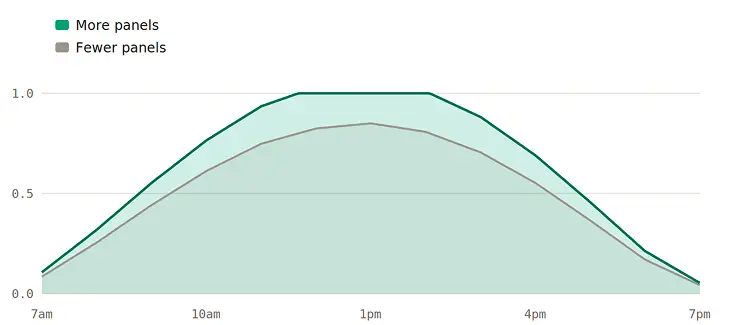
More panels (teal) can help the panels start generating earlier, produce more through midday, and continue producing later into the evening – more solar electricity available for your home to use directly.
More panels, more electricity – start to finish
An inverter won’t switch on until the panels feed it a minimum voltage. More panels reach it sooner in dim light – so the system starts earlier and runs longer toward evening.
In between, more panels mean more power all day. The result is a stronger generation curve:
- Earlier start
- Higher output through the day
- Later finish
And the area under the curve is your electricity. Bigger curve, more kilowatt-hours into your home.
How far is too far
Push the ratio too high and the panels out-produce the inverter. The inverter caps its output and dumps the surplus – that’s clipping. The cost depends on how hard you push.
Moderate (1.3) – minutes a day.
A few short midday peaks, around 3% a year. Advanced inverters absorb brief spikes above their rating, so you lose almost nothing.
Aggressive (2.0) – hours a day.
The inverter is the bottleneck for six or seven hours every clear day, throwing away 20–25% of the energy generated – panels you paid for, producing electricity your inverter cannot use.
The optimal size, not the maximum
The right number of panels isn’t the most you can fit. It’s the balance of three things: system cost, clipping losses, and total generation.
Up to a point, extra panels can make sense – they recover losses from heat, roof angle, orientation, shading and other real-world conditions. That is why good solar design is not about maximising the number of panels; it’s about maximising usable electricity and savings.
A DC/AC ratio of 1.2–1.3 is normal, and the rule of thumb is to not push past 1.5. A little clipping is fine – more panels can still generate and save more, especially in homes with heavy daytime usage.
There’s also an export cap. Under Solar ATAP’s Maximum Allowable Quantity (MAQ), the most you can export is 5 kWh per kWac each day (5 × kWac × days in the month), counted after your own direct use. A 10kWac system can export about 1,500kWh a month – any surplus beyond that earns you nothing.
Go beyond that and the balance tips: the extra clipping and panel cost outweigh the extra generation. You end up paying for more panels without seeing the savings.
A limit on panels per string
Panels in a string add their voltage. Every inverter has a maximum DC voltage – around 600V on small units, up to 1,000–1,500V on larger ones. Cross it and you’re overfeeding the inverter.
"Over the limit, you degrade the inverter and void its warranty."
For example, if each panel is around 40V panels and the inverter limit is 600V, the absolute theoretical ceiling is:
600 ÷ 40 = 15 panels
But a good design would not hit the ceiling – voltage can rise in cooler conditions, so the system needs a safety buffer.
Oversizing does not mean simply adding more panels anywhere. It means adding the right number of panels, wired correctly, within the inverter’s safe limits.
What the rules say about oversizing
There’s no written rule capping panel oversizing – just good-practice guidelines from the government’s installer-certification training.
The hard limit is kWac: your approved AC capacity. You size panels freely; the inverter rating stays within what’s approved.
The authorities may ask us to justify a system’s sizing – so we design to numbers we can defend, not oversize for the sake of it.
How we decide how many panels
- Start with the heat. A base oversize to recover the 10–15% a hot roof takes off the rating.
- Read the roof. Add for tilt, orientation, mismatch and any shading.
- Match your usage. Daytime-heavy home? Make the curve fuller with a little more.
- Stay inside the inverter limit. Keep clipping tiny, respect the string voltage, never exceed the approved kWac.
Add it up and most homes land at a 1.2–1.3 ratio – higher only when the roof genuinely needs it, and rarely past 1.5.
Enough to beat the heat and your roof – no more
Every extra panel should earn its place: closing the heat gap, fixing a roof handicap, or covering your daytime usage. Past that, you’re just paying for energy the inverter will clip away.
The most usable electricity per Ringgit – nothing wasted.
Related articles