Emit Solar | Home Solar Panels | Easy Ownership
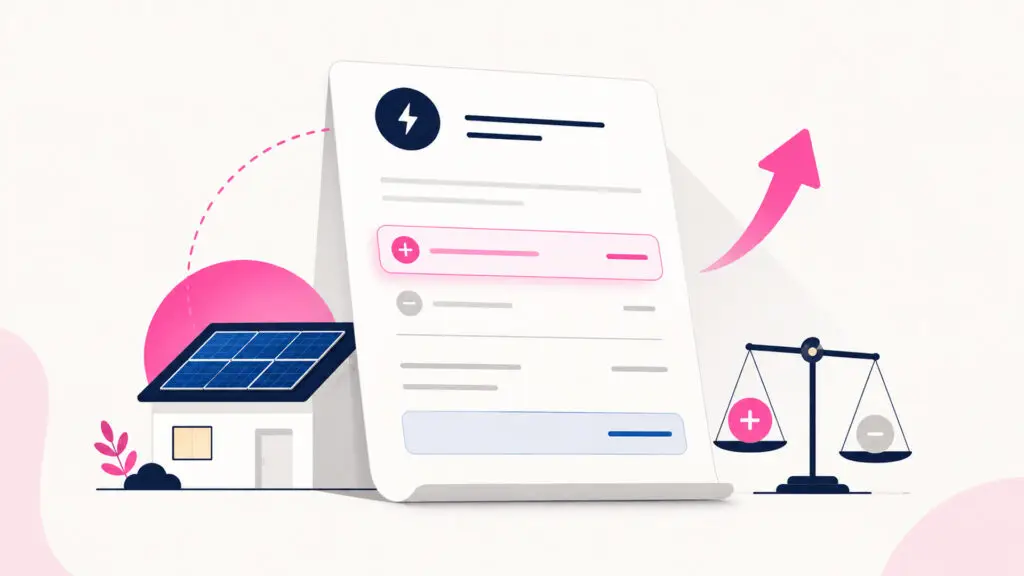
Your electricity bill isn’t just about how much you use.It’s a live feed of global energy chaos – coal markets, currency swings, and distant wars.
That’s where AFA comes in.
What is AFA?
AFA (Automatic Fuel Adjustment) is the difference between what fuel was expected to cost – and what it actually costs.
Simple in theory. Messy in practice.
Why AFA Exists
Before AFA, we had ICPT – which also adjusted for fuel costs, but not consistently. Some households got discounts, while others paid surcharges, even when the underlying cost per kWh was identical for both. The gap was covered through government subsidies.
With AFA:
- Fuel cost adjustments are applied more consistently
- Pricing is more direct and transparent
it’s the cleaner fix – and it’s here to stay.
Ask to see physical copies of all three. A legitimate, professional company will present them without hesitation. If a company can’t or won’t show you their licences, walk away – no matter how attractive the quote.
Where Your Money Actually Goes
Every sen you pay breaks down into three parts.
|
Component
|
Under 1,500 kWH
|
Over 1,500 kWH
|
|---|---|---|
|
Energy (fuel)
|
27.03 sen/kWh (61%)
|
37.03 sen/kWh (68%)
|
|
Capacity
|
4.55 sen/kWh (10%)
|
4.55 sen/kWh (8%)
|
|
Network
|
12.85 sen/kWh (29%)
|
12.85 sen/kWh (24%)
|
|
Total
|
44.43 sen/kWh
|
54.43 sen/kWh
|
Only one of these moves: Fuel. And it’s the big one. That’s the part that AFA adjusts.
And because fuel is globally priced:
"Your electricity bill is now tied to global markets."
92.4% of Our Electricity Is at the Mercy of Global Markets
Coal and gas. That’s what powers Malaysia.
Coal
58.8%
of our electricity
Gas (LNG)
33.6%
of our electricity
Total Exposure
92.4%
tied to global prices
Malaysia’s Monthly Generation Mix, March 2026. Source: Single Buyer.
And both are priced in USD on global commodity exchanges. Every time the Ringgit weakens or a conflict disrupts supply, it hits your pockets.
“ The real test of a solar company isn’t the day they install your system – it’s the day something goes wrong. ”
How Far Off Were the Assumptions?
When the current tariff was set, planners locked in numbers for coal prices and the exchange rate.
Here’s what actually happened:
|
Metric
|
Assumed
|
Jun ’25
|
Sep ’25
|
Dec ’25
|
Mar ’25
|
|---|---|---|---|---|---|
|
Coals (USD/Tonne)
|
97.00
|
99.93
|
98.53
|
104.98
|
103.33
|
|
MYR/USD
|
4.29
|
4.41
|
4.31
|
4.22
|
4.06
|
|
Coal (MYR equiv.)
|
416.13
|
440.69
|
424.66
|
443.02
|
419.52
|
|
LNG (MYR/mmBTU)
|
35.00
|
34.84
|
34.46
|
32.25
|
30.05
|
Malaysia’s Generation Tariff. Source: Single Buyer.
- Coal prices moved above assumptions
- Currency shifted
- Fuel costs fluctuated
When assumptions are off, AFA comes in to adjust the prices.
Why the Discount Is Shrinking
For a while, AFA worked in your favour.
- Stronger Ringgit
- Global glut of coal and gas
- Lower-than-expected costs
You got a discount. But it’s reversing.
Geopolitical tensions are squeezing supply. Coal prices are above the assumed level. The AFA discount is getting smaller – and may flip to a surcharge.
The concern isn’t just price: it’s availability. There’s a real scenario where countries have the money to buy fuel but nobody will sell. With all these uncertainties, countries may also buy more to hoard supply as strategic reserves.
The Bill Glitch Nobody Talks About
Not everyone is exposed to AFA in the same way.
Households using below 600 kWh are excluded – no discount when fuel prices drop, no surcharge when it rises. The result? A cliff edge.
At the peak AFA discount in November 2025:
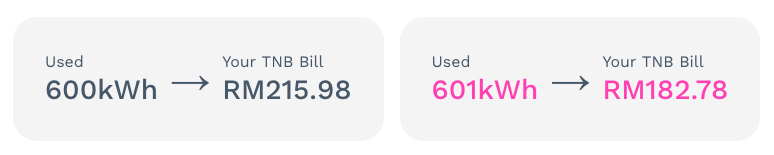
One extra unit of electricity. Thirty-three ringgit cheaper.
AFA is meant to reflect the true cost of electricity. But in practice, some users are shielded while others are fully exposed. So the signal isn’t perfectly clean.
The Honest Scorecard
What Works
- Fully transparent – all the inputs are public data
- Forces real energy literacy on all of us
- Tracks actual costs more honestly than ICPT did
What Doesn’t Work
- One war, one storm, one bad quarter – your bill moves
- Prices go up fast; they never quite come back down
- The 600 kWh cliff
We feel the better version of this system would smooth these swings: Save during good times and cushion during bad times.
Want to reduce your exposure to AFA?
The less electricity you buy from TNB, the less global prices affect your bill. Click the button below to see how much solar can help.
Recent articles