Emit Solar | Home Solar Panels | Easy Ownership
You saw an efficiency rebate, then a line that took some of it back. Here’s the whole thing in plain terms, and why solar still wins easily.
Quick read
The EEI is a rebate for low electricity users. The less you get from TNB, the bigger it is.
That “reversal” line is not a penalty for going solar.
It adjusts the Solar Electricity you sold to TNB to equal what TNB charges you.
You get lower charges from TNB in totality with solar.
What a unit of electricity costs – and your rebate
Every unit you buy from TNB costs about 44 sen: the energy itself (~27 sen) plus fixed grid charges (~17 sen) that apply to every unit you buy, solar or not.
One unit of TNB power
≈ 44 sen
Energy : 27 sen
Grid Charge : 17 sen
There’s also a rebate on that energy charge, called the Energy Efficiency Incentive (EEI). It’s the government’s way of rewarding you for using less. If your home uses 1,000kWh or less in a month, money comes back on a sliding scale: the less you use, the bigger the rebate per unit.
A very light user (200kWh or less) gets the full 25 sen off every unit, so their energy works out to about 2 sen/kWh instead of 27 sen. The rebate shrinks as you use more, and disappears once you pass 1,000kWh a month. It’s applied automatically from your monthly usage – there’s nothing to claim. Keep it in mind: it’s the key to everything below.
Here’s what the EEI does to the energy rate you actually pay:
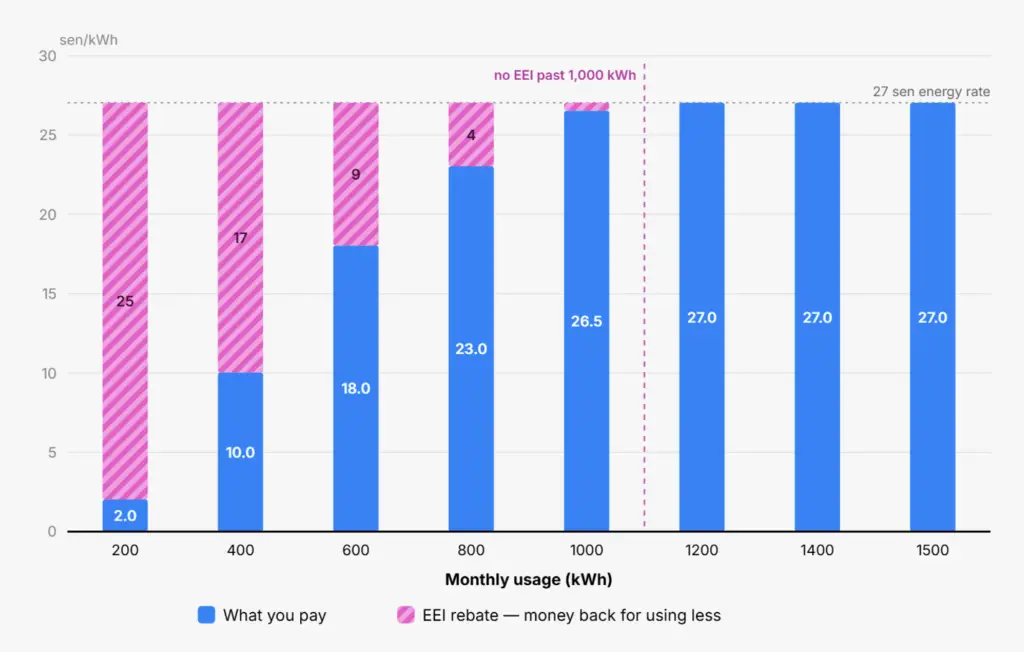
Each bar is the 27 sen energy rate. The EEi rebate (stripped pink) is what lowers it forlighter users – the less you use, the more comes off. until it runs out past 1,000 units a month. Grid changes of ~17 sen a unit sit on top and are the same either way.
Where your Solar Electricity goes
Your panels do two things: power your home with Solar Electricity during the day and sell the extra to TNB under Solar ATAP. When solar is not enough or at night, your home seamlessly draws electricity from TNB.
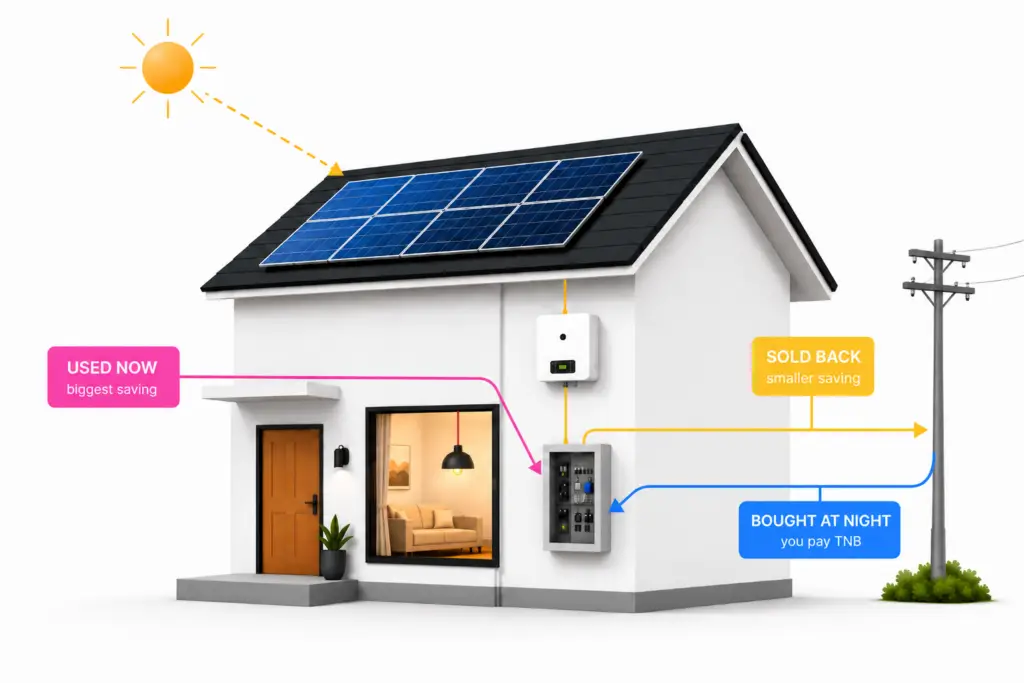
Using your own Solar Electricity is better
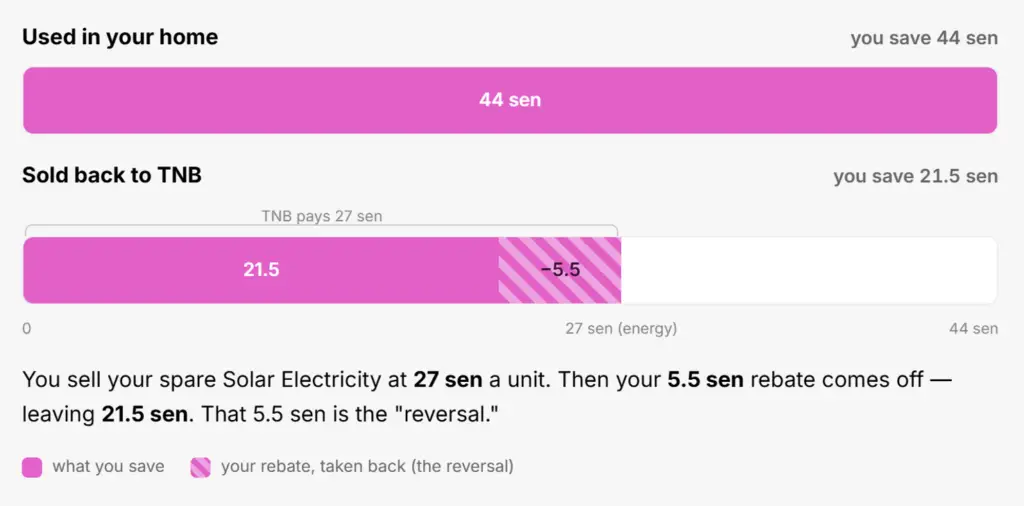
Let’s assume your home uses about 1,000kWh of TNB electricity a month before solar, and after using Solar Electricity it only buys roughly 700kWh from TNB, which puts it in the 5.5 sen rebate band. For this example: use 1kWh of Solar Electricity directly and you save its whole cost, about 44 sen. Sell it to TNB and you only save the energy part (27 sen), minus that 5.5 sen rebate.
Why the rebate comes off what you sell
The rebate is an incentive for buying less from TNB. So it only counts on TNB Electricity you actually buy, not on Solar Electricity you sell. Adjust the EEI and you’re left with a fair, one-for-one swap: you get credited at the same price you paid TNB.
If you buy the same amount of TNB Electricity as the Solar Electricity you sell, under Solar ATAP, your energy charges are zero.
A real month
Here’s a real month, before and after solar – only the energy part of your bill. Capacity, network and retail charges are the same either way, so solar doesn’t touch them.
Your home used
1,000 kWh
300kWh from panels
700kWh bought from TNB
Your panel made
800 kWh
300kWh used at home
500kWh sold to TNB
Without solar
Energy – 1,000kWh
RM270.30
EEI Rebate
– RM5.00
–
–
–
–
You’d pay
RM265.30
With solar
Energy – 700kWh
RM189.21
EEI Rebate
– RM38.50
Sold back – 500kWh
– RM135.15
EEI Reversal
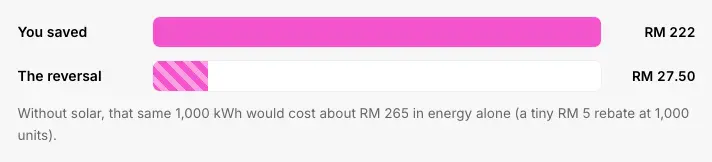
RM27.50
You pay
RM43.06
You save – energy charge only:
RM222.24
The reversal is tiny next to what you saved.
Solar even lifts your rebate
Buying less from TNB pushes you into a bigger rebate band, so solar quietly makes your rebate grow, not shrink:
|
|
You Buy
|
Rebate / unit
|
Net rate / unit
|
|---|---|---|---|
|
Without Solar
|
1,000
|
0.5 sen
|
21.5 sen
|
|
With solar
|
700
|
5.5 sen
|
21.5 sen
|
The more of your own solar you use directly, the less you take from the grid — and the bigger the rebate on what’s left. Higher rebate, and cheaper units.
Three ways to come out further ahead
1. Use Solar Electricity while the sun’s up. Run washing, water heating and aircon in daylight – that’s the “save everything” kind.
2. A bigger system helps. More generation means fewer units bought from TNB – cheaper straight away, and with the EEI, each unit you do buy is cheaper too (the rebate grows the less you buy).
3. Don’t oversize just to sell. Under Solar ATAP you can’t roll spare credits over to the next month, so any Solar Electricity you export beyond what your bill absorbs is simply wasted. Size the system to how your home actually uses electricity, not to a brochure number.
THE ONE LINE TO REMEMBER
The reversal isn’t a penalty. It’s the rebate staying honest. Use more of your own sun, and your bill only gets better.
Want this worked out on your own bill?
We’ll read your actual TNB bill line by line and size a system to how your home really uses electricity. Get a straight answer from us – no deposit, no commitment, we come to you.
Recent articles