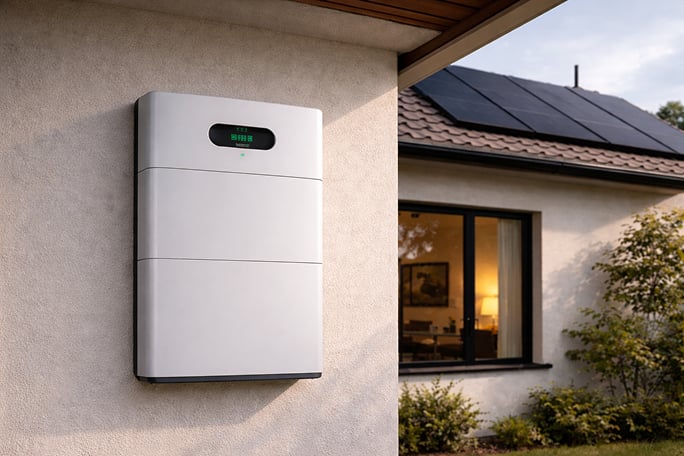
Should You Get A Battery For Your Solar Setup?
The short answer: No for most homes.
In Malaysia today. Solar ATAP already gives you a “virtual battery” through TNB, making physical batteries hard to justify on cost alone if “savings” is your key objective.
Furthermore, TNB is fantastically reliable even by global standards, so you rarely need a battery for “backup power”.
Why Most Homes Don’t Need A Battery
A battery stores excess Solar Electricity for use at night.
But under Solar ATAP (see how it works →), you don’t need to store it yourself. You can sell excess Solar Electricity to TNB during the day and receive credits on your bill, then use those credits to offset your night usage.
So instead of spending thousands on a battery, you can simply “store” your Solar Electricity with TNB and use it later.
The Cost Of Using TNB As Your “Battery”
If you use TNB as your battery, there is a cost involved – the difference between what you pay for electricity and what you sell it for.
RM0.17/kWh is effectively the cost of “storing” your Solar Electricity with TNB – without needing a physical battery.
(This can get a bit complicated with Malaysia’s complex electricity charges like AFA, KWTBB, SST.)
When Does a Battery Make Financial Sense?
RM500
per kWh
To make a physical home battery worth the investment (aiming for an 8-year break-even), the cost of the battery needs to drop below RM500 per kWh.
Today, most high-quality lithium-ion batteries still sit well above this price point.
That’s why, for now, the numbers don’t make sense for most households.
Why Waiting Might Be Your Best Move
If you’re not in a rush, holding off on a physical battery makes sense:
Battery Prices Are Trending Down
New technologies like sodium-ion are expected to be significantly cheaper than today’s lithium-ion tech.
Solar Panel Prices May Increase
Supply chain shifts could push prices slightly higher.
Opposite Trends
Batteries are getting cheaper. Solar panels may not be.
Solar Is Already Delivering Savings Today
You don’t need a battery to start reducing your TNB bill under Solar ATAP.
Install solar now.
Decide on a battery later.
The Game Changer: Your EV Is A Battery (V2X)
Why buy a stationary battery when you may already have one in your porch?
V2X (Vehicle-to-Everything) technology is starting to roll out in Malaysia and certain EVs allow you to use the car’s battery to power your home.
The strategy:
Charge your car for “free” during the day using your solar panels, then use the car to power your home at night. Every kWh used to charge your car avoids 100% of the TNB tariff per kWh – without any “storage” cost.
Every kWh used to charge your car avoids 100% of the TNB tariff per kWh – without any “storage” cost.
Most EV cars today also support “scheduled charging”, so you can just keep your car plugged in all the time and it would charge at specific times.
Your EV can literally become your home battery.
So, What Are Your Best Options Today?
-
Shift your usage
Do laundry, charge your EV, or do your heavy cooking during the day.
-
Pre-cool your home
Turn your AC on in the afternoon while the sun is out to keep the house cool for the evening.
-
Choose a reputable brand
Make sure the company is stables enough to still be around in 10 years.
-
Size for degradation
Batteries naturally lose about 20% capacity over a decade. Size larger to account for this.
The Bottom Line
-
The grid remains your most cost-effective “battery.”
-
Solar ATAP lets you save without the upfront cost of storage.
-
You can always add a battery later – you don’t need one to start saving today.
-
Pair solar with an EV car to “suck up” Solar Electricity
Want To See If Solar Alone Works For You?
Click the button below to see the numbers in under 30 seconds.
Calculate My Savings